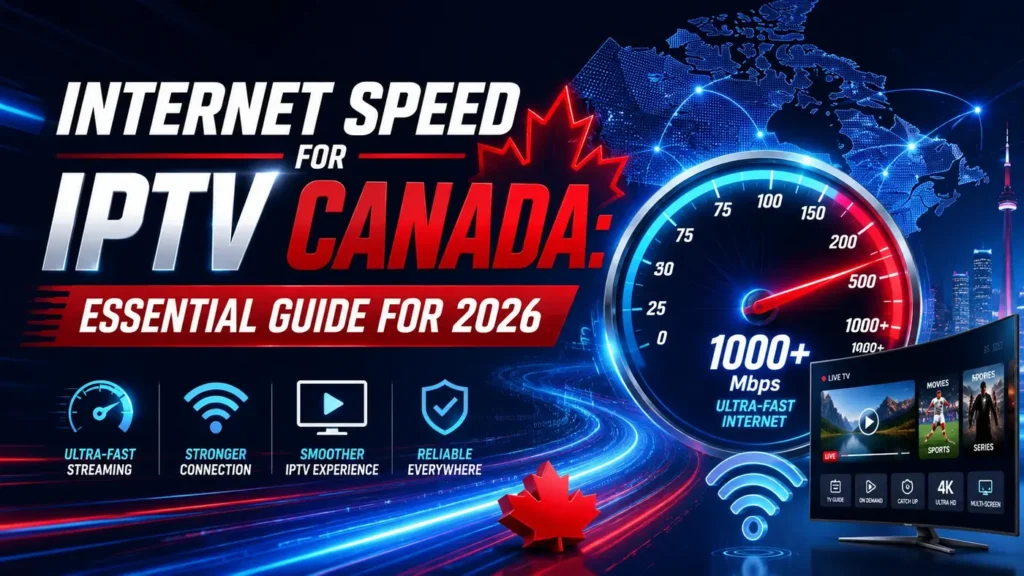
Internet Speed for IPTV Canada: Essential Guide for 2026
Choosing the right internet speed for IPTV Canada is important if you want smooth streaming at home. Many users think IPTV problems always come from the service, but in many cases, the real issue is the speed reaching the device, the WiFi signal, or the number of devices using the same connection.
In 2026, Canadian users watch IPTV on Smart TVs, Firestick, Android TV, phones, tablets, laptops, and TV boxes. Each device needs a stable connection to load streams properly. If the connection is weak, overloaded, or inconsistent, IPTV may buffer, freeze, load slowly, or reduce picture quality.
This guide explains what affects internet speed for IPTV Canada, how real device speed is different from your internet plan, and what users should check before blaming the IPTV app or subscription.
Why Internet Speed Matters for IPTV in Canada
Internet speed matters because IPTV depends on a constant flow of data. When you watch IPTV, your device receives video through the internet. If that data arrives smoothly, the stream plays normally. If it arrives too slowly or stops for short moments, the viewing experience can become unstable.
For Canadian users, internet speed for IPTV Canada should be understood as part of the full home setup. The subscription can be active, the app can be installed, and the device can be ready, but if the connection is not strong enough, the result may still feel poor.
Speed affects several parts of IPTV viewing. It can affect how fast content loads, how stable the stream feels, how quickly the app responds, and whether the picture stays clear during playback.
This is why users should check internet speed early. It helps separate service issues from home connection issues. If your internet is weak, fixing the home connection may improve IPTV without changing the subscription.
Internet Plan Speed vs Real Device Speed
One common mistake is thinking that the internet plan speed is the same speed reaching the IPTV device. That is not always true.
Your internet provider may offer a certain speed, but the actual speed on your Smart TV, Firestick, Android TV, or phone can be lower. This can happen because of WiFi distance, router position, walls, interference, or too many devices using the same network.
For example, your router may receive strong speed, but your TV in another room may receive a weaker signal. In that case, the issue is not the internet plan itself. The issue is the speed reaching the device you use for IPTV.
When checking internet speed for IPTV Canada, users should test speed near the device they actually use. Testing on a phone beside the router may give a better result than the TV receives in the living room.
This difference is important because IPTV performance depends on the real device connection, not only the number written in your internet package.
What Affects IPTV Speed at Home
Several things can affect IPTV speed at home. The first is WiFi strength. If the signal is weak, IPTV may struggle even when the internet plan is fast.
The second factor is bandwidth sharing. If many devices are connected at the same time, each device may use part of the connection. Phones, laptops, gaming consoles, tablets, and Smart TVs can all reduce available bandwidth.
The third factor is router placement. A router hidden behind furniture, placed too far away, or blocked by walls may give weaker signal to the IPTV device.
The fourth factor is device performance. An older Smart TV or overloaded streaming device may not handle the app smoothly, even if the connection is good.
For better internet speed for IPTV Canada, users should look at the full setup. Speed is not only about the provider. It is also about how the connection moves through the home and reaches the device.
If your IPTV problem looks more like loading circles and slow playback, this guide about IPTV buffering Canada explains that issue in more detail.
HD, Full HD, and 4K Need Different Stability Levels
Different video qualities need different stability levels. A basic stream may work on a weaker connection, but HD, Full HD, and 4K usually need a stronger and more stable setup.
4K viewing needs more data than HD. If the connection is not stable enough, the picture may drop quality, buffer, or freeze. This does not always mean the IPTV service is broken. It may mean the home connection is not strong enough for higher-quality playback.
For internet speed for IPTV Canada, users should think about what they expect from the service. If you mainly watch in HD, your needs may be lower. If you expect 4K quality on a large screen, the setup needs to be stronger.
A stable HD experience is often better than unstable 4K. If the highest quality creates buffering or freezing, it may be better to focus on smooth playback first.
The goal is not only high numbers. The goal is a consistent connection that keeps the stream stable during real viewing.
WiFi Can Reduce Your Real IPTV Speed
WiFi is convenient, but it can reduce the real speed reaching your IPTV device. This is one of the most common reasons users face streaming problems at home.
A WiFi signal can become weaker because of distance, walls, router position, interference, or too many connected devices. Even if the speed beside the router is good, the speed near your TV may be lower.
When checking internet speed for IPTV Canada, it helps to test the connection from the same place where you watch. If the speed is much lower there, WiFi may be the weak point.
Simple changes can help. Move the router to a more open place, reduce obstacles between the router and the device, restart the router, or try watching closer to the WiFi source.
If your main device supports Ethernet, testing a wired connection can also help you understand whether WiFi is causing the issue. We will cover WiFi and Ethernet comparison in a separate article later, but for now, the main point is simple: weak WiFi can reduce real IPTV speed.
Bandwidth Sharing With Other Devices
Bandwidth sharing is another important part of internet speed for IPTV Canada. A home connection is shared by all connected devices. If many devices are active at the same time, IPTV may not get enough bandwidth.
This can happen during evening hours when people are home. One person may be gaming, another may be watching videos, a phone may be updating apps, and a laptop may be downloading files. All of this can affect IPTV performance.
If your IPTV works better when fewer devices are connected, the issue may be bandwidth pressure. This is especially common in homes where many people use the same internet connection.
To test this, pause large downloads, stop unused streams, close background apps, and try IPTV again. If the stream improves, your connection may be overloaded during normal use.
This does not always mean your internet plan is bad. It may simply mean your home network is too busy at certain times.
How to Test Your Speed Before Watching IPTV
Testing your speed is one of the easiest ways to understand your connection. But the test should be done correctly.
Do not only test beside the router. Test from the place where you actually use IPTV. If you watch on a Smart TV in the living room, test near that area. If you watch on Firestick, test close to that device.
You can use an internet speed test to check your current connection before watching.
When testing internet speed for IPTV Canada, check more than one time. Test during the day, then test again during evening hours. If the evening result is much weaker, peak-hour pressure may affect your streaming.
Also check whether the problem happens on one device or several devices. If only one device has weak speed, that device or its WiFi position may be the problem. If all devices are slow, the connection itself may need attention.
A speed test does not solve everything, but it gives you useful information before contacting support.
When Speed Is Not the Only Problem
Internet speed is important, but it is not the only thing that affects IPTV. Some users have good speed but still face freezing, lag, or loading issues.
This can happen when the connection is unstable. A speed test may show a good number, but the connection may still drop for short moments during playback. IPTV needs consistency, not only high speed.
Device performance can also create problems. An old Smart TV or overloaded streaming device may struggle even with a good connection.
App behavior matters too. If the app is slow, outdated, or full of cache, the stream may not feel smooth.
For a broader explanation of stability problems, this guide about IPTV stability Canada explains how speed, WiFi, buffering, freezing, and device performance work together.
If your stream stops suddenly instead of loading slowly, this guide about IPTV keeps freezing Canada may help you understand the difference.
For Canadian users looking for a home-focused IPTV starting point, iptv maple can help you explore a service built for Canadian viewing needs.
Final Thoughts
Choosing the right internet speed for IPTV Canada is about more than checking your internet plan. What matters most is the real speed reaching your streaming device and how stable that connection stays during viewing.
Before blaming the IPTV service, check your WiFi strength, router position, connected devices, and real device speed. Test during different times of the day and compare results.
A smooth IPTV experience depends on speed, but also on stability, bandwidth, device performance, and app behavior. If these parts work together, IPTV becomes easier to enjoy at home.
In 2026, Canadian users can improve streaming by testing speed correctly, reducing network pressure, and making sure the main IPTV device gets a strong and stable connection.
FAQ
A good internet speed for IPTV Canada depends on the quality you want to watch. Basic viewing may need less speed, while HD and 4K need a stronger and more stable connection.
No. IPTV can buffer because of weak WiFi, too many connected devices, router position, device performance, or an unstable connection, not only low speed.
Test near the device you use for IPTV. The speed near the router may be higher than the speed reaching your Smart TV, Firestick, or Android TV.
Yes. 4K needs more bandwidth and better stability than HD. If the connection is weak, 4K may buffer, freeze, or drop quality.
Yes. WiFi can reduce real device speed because of distance, walls, interference, and connected devices. Ethernet is often more stable when available.