IPTV Quality Drops Canada: Why Picture Quality Changes
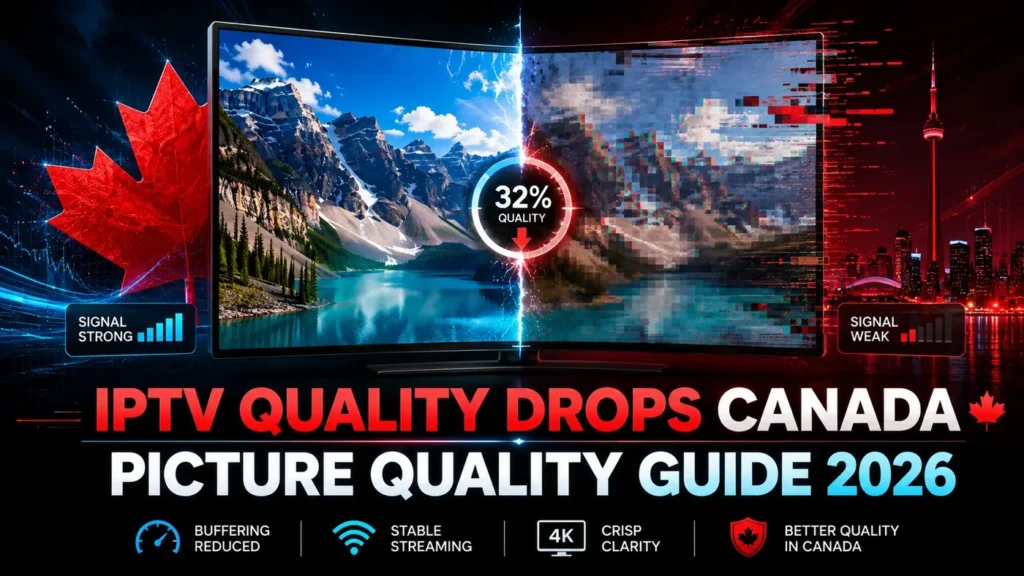
When IPTV quality drops Canada becomes a problem, the stream may still play, but the picture does not stay clear. The image may start in HD or 4K, then suddenly become softer, blurry, pixelated, or less sharp. For many users, this feels confusing because the video does not always stop; only the quality changes.
This issue is different from buffering or freezing. Buffering means the stream pauses to load. Freezing means the picture stops. Quality drops mean the stream continues, but the image loses clarity during playback.
In 2026, Canadian users watch IPTV on Smart TVs, Firestick, Android TV, phones, tablets, laptops, and TV boxes. Each setup can affect picture quality differently. This guide explains why IPTV quality drops Canada happens, what users should check first, and how to understand whether the issue comes from the connection, device, app, or stream stability.
What IPTV Quality Drops Canada Means
IPTV quality drops Canada means the picture quality changes while watching. The stream may begin clearly, then become blurry or less detailed. Sometimes HD may look like SD. Sometimes 4K may not stay sharp. Sometimes the image quality may go up and down during the same session.
This can happen for a few reasons. The connection may become unstable. The WiFi signal may weaken. The device may struggle with higher-quality playback. The app may reduce quality to keep the stream playing. Home network pressure can also affect the result.
The important point is that quality drops are not always the same as a broken stream. In many cases, the app or stream continues playing, but the setup cannot keep the highest quality stable.
For Canadian users, this issue often becomes more visible on larger screens. A small quality drop may not look serious on a phone, but it can be very noticeable on a big Smart TV.
Why Picture Quality Changes During Streaming
Picture quality changes when the stream cannot maintain the same level of video data consistently. Higher-quality video needs more stable delivery. If the connection weakens or the device struggles, the app may reduce the picture quality so playback can continue.
This is why IPTV quality drops Canada can happen even when the stream does not fully stop. The system may try to avoid buffering by lowering the quality. Instead of pausing the video, the image becomes less sharp.
Several factors can cause this:
- weak WiFi signal
- unstable internet connection
- too many connected devices
- peak-hour network pressure
- older streaming device
- app performance issues
- high-quality stream requiring more bandwidth
- device far from the router
For a simple explanation of picture quality concepts, this guide about video quality basics can help.
When picture quality changes often, users should check the full setup instead of assuming the IPTV service is the only cause.
Quality Drops Are Different From Buffering
Quality drops and buffering can happen together, but they are not the same.
Buffering means the stream pauses because it needs more data before continuing. You may see a loading circle, a pause, or playback that stops and starts again.
Quality drops mean the stream continues, but the picture becomes weaker. The app may reduce the image quality to keep the video playing instead of stopping completely.
If your main problem is loading circles or playback pauses, this guide about IPTV buffering Canada explains that issue more clearly.
With IPTV quality drops Canada, the issue is more about visual consistency. The stream may stay active, but the image does not stay at the same level.
This difference matters because the checks are slightly different. For buffering, users often check loading, bandwidth, and speed. For quality drops, users should also check device power, stream quality, screen size, app behavior, and whether the setup can maintain HD or 4K.
How Internet Speed and Bandwidth Affect Quality
Internet speed affects picture quality because higher-quality streams need more data. If the speed reaching your IPTV device is weak or inconsistent, the picture may drop quality during playback.
However, the speed written in your internet plan is not always the speed reaching your Smart TV, Firestick, Android TV, or TV box. The real device speed may be lower because of WiFi distance, router position, walls, or connected devices.
For IPTV quality drops Canada, bandwidth sharing is also important. If several devices are using the internet at the same time, IPTV may not receive enough steady bandwidth to keep the picture clear.
For example, if one person is gaming, another is streaming videos, and a laptop is downloading updates, your IPTV device may reduce quality because the connection is under pressure.
If you want to understand speed more clearly, this guide about internet speed for IPTV Canada explains how real device speed affects streaming.
A stable connection matters more than a high number that changes constantly.
Why 4K and HD Can Drop During Playback
4K and HD streams need stronger stability than lower-quality streams. If the setup is not strong enough, the stream may lower quality during playback.
This is common when users expect 4K on a weak WiFi connection or on a device that cannot handle high-quality playback smoothly. The stream may start sharp, then become less clear when the connection or device cannot keep up.
For IPTV quality drops Canada, 4K problems are often easier to notice because the difference between sharp 4K and reduced quality is more visible on a large screen.
If your 4K stream keeps losing quality, it may not mean that 4K is impossible. It may mean your current setup needs better stability, stronger device performance, or a more consistent connection.
This guide about IPTV 4K streaming Canada explains what users should check before expecting smooth 4K viewing.
Sometimes, stable HD is better than unstable 4K. A clear and consistent picture is usually more enjoyable than a high-resolution stream that keeps dropping quality.
Device and App Performance Can Affect Picture Quality
The device you use can affect IPTV picture quality. Older Smart TVs, overloaded Firestick devices, weak Android TV boxes, and full-storage devices may struggle with higher-quality playback.
If the device is slow, the app may not handle the stream smoothly. This can lead to visual changes, slower response, or unstable playback.
For IPTV quality drops Canada, device performance should be checked if the issue happens only on one screen. If the same stream looks better on another device, your main device may be part of the problem.
Apps can also affect picture quality. If the app is outdated, overloaded, or running for a long time, it may not perform well. Restarting the app can sometimes improve playback.
Simple device habits can help:
- restart the device before long sessions
- close unused apps
- remove apps you do not need
- keep enough storage free
- avoid running too many background processes
- test another device when possible
A clean device setup can make the stream feel more stable and reduce quality changes.
WiFi Weakness and Home Network Pressure
WiFi weakness is one of the most common reasons picture quality changes. A device can show that it is connected, but the signal may still be weak or unstable.
Distance from the router, walls, furniture, router position, and interference can all reduce WiFi quality. If the WiFi signal drops during playback, the app may reduce picture quality to keep the stream running.
For IPTV quality drops Canada, WiFi should be checked especially when the issue happens on the main TV. A phone close to the router may work well, while a Smart TV in another room may receive weaker signal.
Home network pressure also matters. If many devices are connected, the IPTV stream may not get enough stable bandwidth. This can make HD or 4K drop to lower quality.
To check this, pause downloads, reduce other streams, close unused apps, and test IPTV again. If the picture stays clearer when fewer devices are active, your home network may be under pressure.
For a broader view of streaming stability, this guide about IPTV stability Canada explains how WiFi, speed, buffering, freezing, lag, and quality problems work together.
Simple Checks Before Contacting Support
Before contacting support, try a few simple checks. These steps can help you understand whether the problem comes from your device, connection, app, or service.
First, test another channel or content. If only one stream has quality drops, the issue may be specific to that stream.
Second, restart the IPTV app. If the app has been running for a long time, it may need a clean start.
Third, restart the device. Smart TVs, Firestick, Android TV devices, phones, and tablets can all benefit from a restart.
Fourth, check WiFi strength. If the device is far from the router, move closer or test a stronger connection.
Fifth, reduce connected devices. Pause downloads, stop extra streaming, and test IPTV again.
For IPTV quality drops Canada, use this quick checklist:
- Test another channel.
- Restart the IPTV app.
- Restart the device.
- Restart the router.
- Check WiFi strength.
- Reduce connected devices.
- Try Ethernet if possible.
- Test another device.
- Compare HD and 4K stability.
- Check whether the issue happens only at night.
For Canadian users looking for a home-focused IPTV starting point, iptv canada can help you explore an IPTV option built for Canadian viewing needs.
These checks make it easier to explain the issue if support is needed.
When Picture Quality Changes Become a Bigger Issue
Occasional quality changes can happen with many streaming setups. But if the picture drops often, especially on the main screen, the issue becomes more important.
Repeated quality drops may mean that your connection is unstable, your WiFi is weak, your device is overloaded, or your home network is under pressure.
For IPTV quality drops Canada, the pattern matters. Does the issue happen only at night? Does it happen only on WiFi? Does it happen only on 4K content? Does it happen on one device or all devices?
If quality drops happen on one device only, check that device and app. If they happen on all devices, check your connection and home network. If they happen only on specific content, the issue may be stream-specific.
When contacting support, explain:
- the device you use
- the app you use
- whether the issue happens on one channel or all content
- whether you use WiFi or Ethernet
- whether the picture drops from 4K to lower quality
- whether buffering or freezing happens too
- what steps you already tried
Clear details help support understand the problem faster.
Final Thoughts
IPTV quality drops Canada usually means the stream continues, but the picture does not stay clear. The image may start sharp, then become blurry, softer, pixelated, or less detailed during playback.
This can happen because of weak WiFi, unstable internet, bandwidth pressure, device limits, app behavior, or high-quality streams that need more stability.
Start with simple checks. Restart the app, restart the device, check WiFi strength, reduce connected devices, and test another stream or device. If the problem continues, contact support with clear details.
In 2026, Canadian users can reduce many picture quality problems by focusing on stability first. A consistent HD stream is often better than unstable 4K, and a clean home setup can make IPTV viewing smoother.
FAQ
IPTV quality drops Canada means the picture quality changes during playback. The stream may continue, but the image becomes blurry, softer, pixelated, or less sharp.
Picture quality can change because of weak WiFi, unstable internet, bandwidth pressure, device limits, app behavior, or high-quality streams that need more stability.
No. Buffering means the video pauses to load. Quality drop means the stream keeps playing but the picture becomes weaker.
4K needs more bandwidth and stronger stability. If the connection or device cannot maintain 4K smoothly, the stream may reduce quality.
Yes. Weak or unstable WiFi can make the stream reduce quality during playback, especially on Smart TVs far from the router.